“Natural movement”?
Humans are built to move
“Natural movement” was the big topic in fitness circles 5–10 years ago, but is still quite relevant to Aikido, and I still incorporate elements of natural movement in my warmups.
This type of movement practice is related to everything that we do with our bodies throughout the day.
Perhaps you have crawled under a fence, crossed a stream on a log, ducked under a branch, or climbed a steep and uneven trail. Or, you have climbed over some rocks, picked up a squirming child, reached for something on a top shelf, or simply stood up and walked around. These are all examples of how both surfaces and obstacles change the way we move. Because environments are variable, it was probably different every time you performed those movements.
Why is this important?
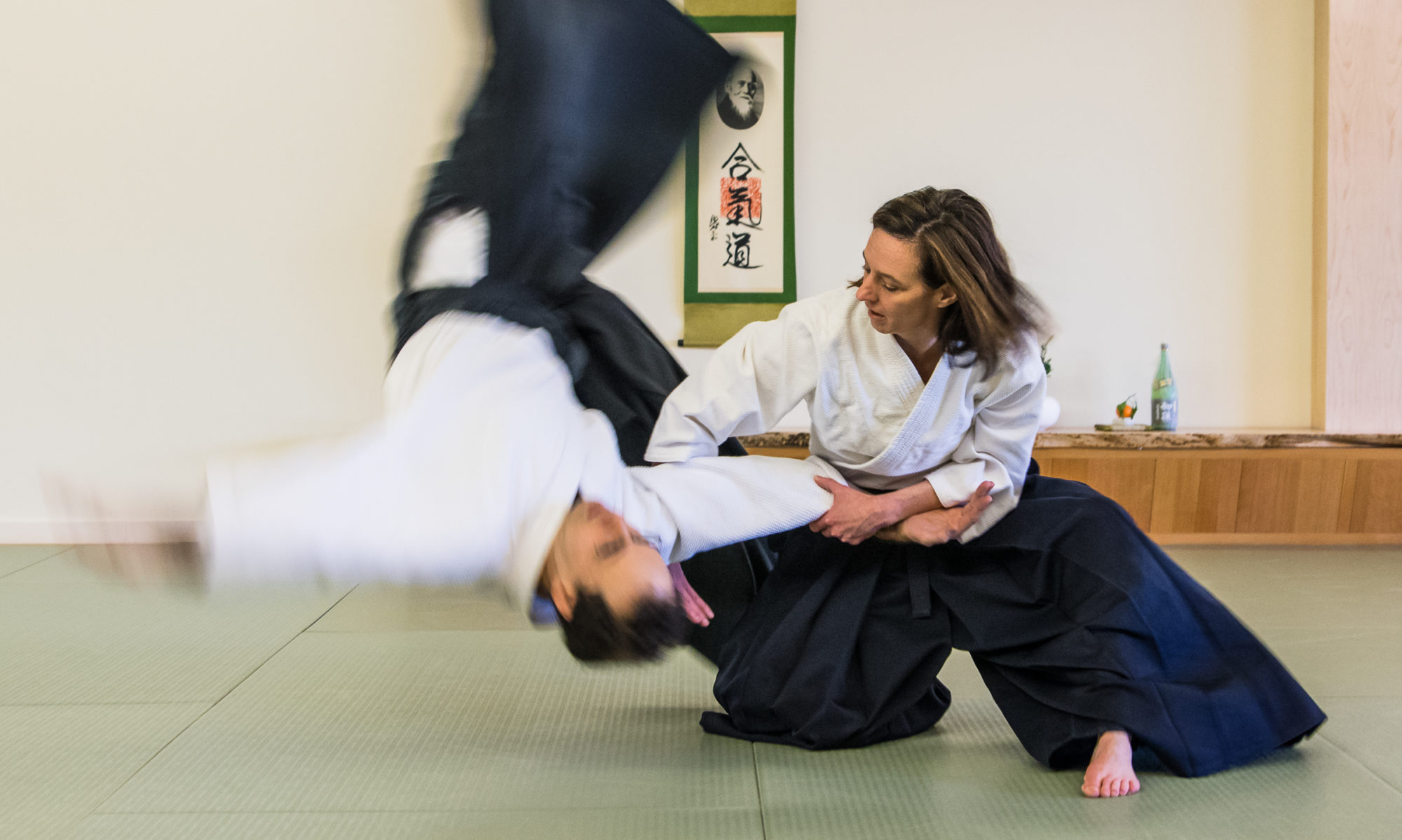
Developing your ukemi in Aikido is a process of finding out how to move naturally while protecting yourself from impact and torsion. Sometimes, ukemi is performed in a split second as a life-or-death response.
Even though it’s performed on a mat, there are still a lot of variables. Your partners’ height, strength, or experience level can vary wildly. So does the speed and intensity at which they are training with you. Your mood, fitness level, and injuries can change from day to day or month to month.
Ukemi is performed differently each time, even for the same technique. It is not proscribed or set in stone. Because we all have different bodies and minds, everyone has a different way of reacting, according to their own proportions, mechanics, flexibility, and abilities.
Why do you need to learn (or relearn) to move?
For beginners in Aikido, there is often a process of “relearning” how to perform natural movements that we learned as kids, like running, falling, rolling, and jumping. We have sat too much, and maybe not played enough.
Returning to (or starting) Aikido can be stressful on the body as we try to regain the flexibility, strength, and endurance we may have lost. It’s important to go slowly, and listen to and support your body.
In Aikido class, we usually start with gentle back rolls to strengthen and add flexibility to the spine, and help beginners to learn to protect their head and neck. Rolling also helps with flexibility in the hips and legs.
Ukemi is highly variable, so reflexes, responsiveness, and connection also need time to be allowed to develop.
In Aikido, we have to change where our center of gravity is depending on what we are doing in that split second. We turn one way and then very quickly in the opposite direction. We turn around our nage’s center, pivot, balance, and sometimes lose that balance. We even begin to be comfortable losing our balance in some situations. We become mindful of our body in space, and how it is reacting to the environment in that moment.
All aikidoka know the joy in being thrown, rolling and jumping back up, or being able to stand up easily after being pinned to the mat. Some of the greatest joy in aikido comes from in fluid natural reactions to throws.
But it can be hard to exercise! “Exercise” isn’t natural. Hunter-gatherers don’t “exercise.” They just take part in the activities of life. For a lot of people, the repetitive nature of exercise can make it difficult and boring.
One of the things I love about Aikido is that Aikido is endlessly novel. There is always something to explore in the movement, and in the interactions with another human. For me, even walking is boring to me. In the city, the majority of the walking or running we do is in shoes, and on solid, level ground. There is not a lot of variety.
So, how do you get some of that novel Aikido energy right now?
Luckily, our bodies are built for these movements and we crave them. We crave the novelty and the exploration of movement, and it is instantly rewarding.
Spend some time squatting, sitting on the floor, exploring how you get down and get back up again. The next time you pick up a stray sock on the floor, or get out of bed, do it as an exploration of how you are doing that movement.
Balance on one foot while you make coffee. Ground your feet on the floor and bring your awareness to the connection between your feet and the surface you are walking on.
See how it feels to build an awareness of the movements you do every day, and try to build an awareness of your environment right now.
And play.